
The Politeness Trap: Why Psychological Safety Requires Friction
True trust isn’t built on polite silence—it’s forged in uncomfortable conversations.

The Well-Meaning Origins of a Buzzword
This might sound odd to say, but the term ‘psychological safety’ has become a term I find a bit annoying nowadays.
Mad, given it’s so critical to a team becoming high performing.
It’s so vital, and yet it’s become misappropriated in ways which, well, hinder psychological safety.
Let me explain…
The term started off as something valuable and well meaning.
Many say it first became a thing because Google’s Project Aristotle tried to understand what factors explained the discrepancy between different team’s performances the best. They looked at IQ, gender balance, team sizes, all sorts of stuff apparently and what they found was that the best teams were the one’s that reported the most mistakes.
At first this seemed odd because how is it that making more mistakes is better. It might be popular to say ‘celebrate failure’ (which I also find annoying) but failing is really not a sign of success.
So digging into it they came across the work of Amy Edmunson and found this concept of psychological safety, which basically is how safe somebody feels to take a risk in their group without fear of disproportionate judgement or recrimination or punishment.
Essentially what they found was that the most successful teams didn’t actually necessarily MAKE more mistakes, they REPORTED more of their mistakes. And therefore, they could learn and grow as a group.
The Politeness Trap and the Safety Fallacy
So far so good.
But then people in the workplace started saying ‘I don’t feel safe’. A lot.
This became a part of the culture wars and has been termed safety-ism and in many groups has become an excuse for all sorts of things.
Perhaps worst of all, it’s become a reason to not have difficult conversations.
And hence why so many teams are so polite.
This has come up with several charities we work with, particularly where safety is so important – without it we can’t have honest conversations. We can’t have constructive feedback and conflict.
And this is the fallacy…
Because one of the absolute best ways to build psychological safety is to have difficult conversations with each other.
Stuck on the Loop: The 4 Stages of Group Development
This can be explained through a different model…
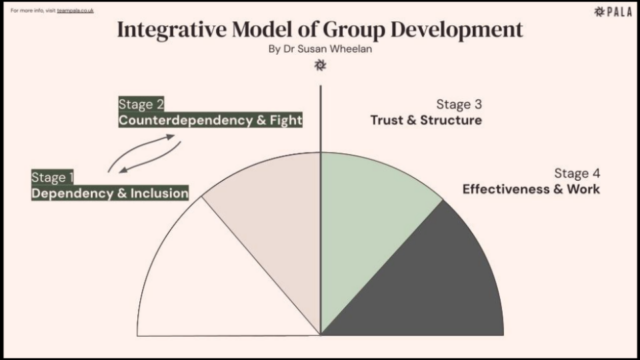
Many of you will be familiar with the old Forming, Storming, Norming, Performing model. This was then given more rigour by Dr Susan Wheelan in her Integrative Model of Group Development, which studied all such models and in essence created a meta-model.
What’s interesting isn’t so much the stages Wheelan came up with, but the way we can make sense of how we go through them. The stages are:
- Stage 1: Inclusion and dependency: The group doesn’t want to feel excluded, so we stay super polite and follow the leader because that feels like we won’t break any social norms.
- Stage 2: Fight and counter-dependency: We start to have opinions at odds with leadership and want to find our own way, want independence and might form cliques. This is a kind of teenage, conflict stage but often the conflict is covert or passive-aggressive.
- Stage 3: Trust & structure: We’ve been through some tough conversations and have learnt a lot together, we’ve riffed and repaired, we’ve shown openness and we feel like we can move forward.
- Stage 4: Performance: We have trust and can focus our energy on the work rather than the dynamics. We have more conflict than ever but rather than that conflict feeling like a threat to our relationships, it is a tool for our work. Where in stage 2 conflict feels like a young couple who could separate at the smallest argument, in stage 4 conflict is more like a mature couple that argues often in short sharp bursts to sort stuff out and then can be holding hands 5mins later.
Now it’s not these stages that are particularly interesting, what is interesting is that almost all groups are perpetually recycling between stages 1 and 2.
We start off polite, we slowly find things annoying so we move to stage 2, but then the heat is too much so we go back. To put it in crude terms, as the philosopher Alan Watts said: “It’s all retch and no vomit, you never quite get there”.
And this has a massive effect on performance!
We only start getting to work in stage 3.
In stages 1 and 2 we’re essentially just spending our energy thinking about what somebody thinks about something I think. And so how do we break through to the type of trust that emerges in stage 3?
How do we break through that barrier?
Safety vs. Comfort: The Anti-Fragile Team
Our answer has become somewhat simple: argue more.
Don’t get me wrong, in our team journeys, we do help groups to do some of the nicer getting to know each other stuff. Particularly we invite people to get to know each other sincerely, to learn about what makes each other tick.
But as soon as possible, we ask groups to bring up difficult topics and the way we do so is to distinguish ‘safety’ from ‘comfort’.
Safety is a pre-requisite of course, without it we can break.
But equally, too much comfort makes growth impossible.
The term in biology for this is ‘hormesis’, the idea that a system needs enough stress to grow. Nassim Taleb called it ‘anti-fragility’.
And so for a team to grow in trust, we need to bring up topics that are ‘safe but uncomfortable’ and we often dedicate sessions to doing just this.
How to Build Trust: Say Hard Things, Listen Better
At first their comfort zones are small, so incredibly small things come up. But slowly bigger topics come up and soon enough really tough conversations come up. About money, about strategy, about behaviour and relationships, and when this happens we ask the whole group to pay attention to how we have this conversation.
We emphasise three things:
- Say hard things.
- Listen really well and show you’re listening really well.
- Repeat.
This increases our comfort zone and trust.
Or to put it in post-modern terms, this help us to create safe spaces.
There is little that is more bonding than going through a slightly difficult conversation with somebody and both coming out feeling heard and understood.
We worked with a group recently where we all acknowledged there was a kind of ‘glow’ to the group after the hard chat.
They had a taste of stage 3.
Flip the Question
And so if you have a group that is too polite and not saying hard things, don’t fall into the trap (excuse) of thinking you need to build safety before having the hard conversations.
It might be more helpful to think of it the other way around:
- What’s the hard(ish) conversation we need to have that will help us build safety?
Make this your practice, and watch your team transform from politely cautious to genuinely high-performing.
More epic articles...
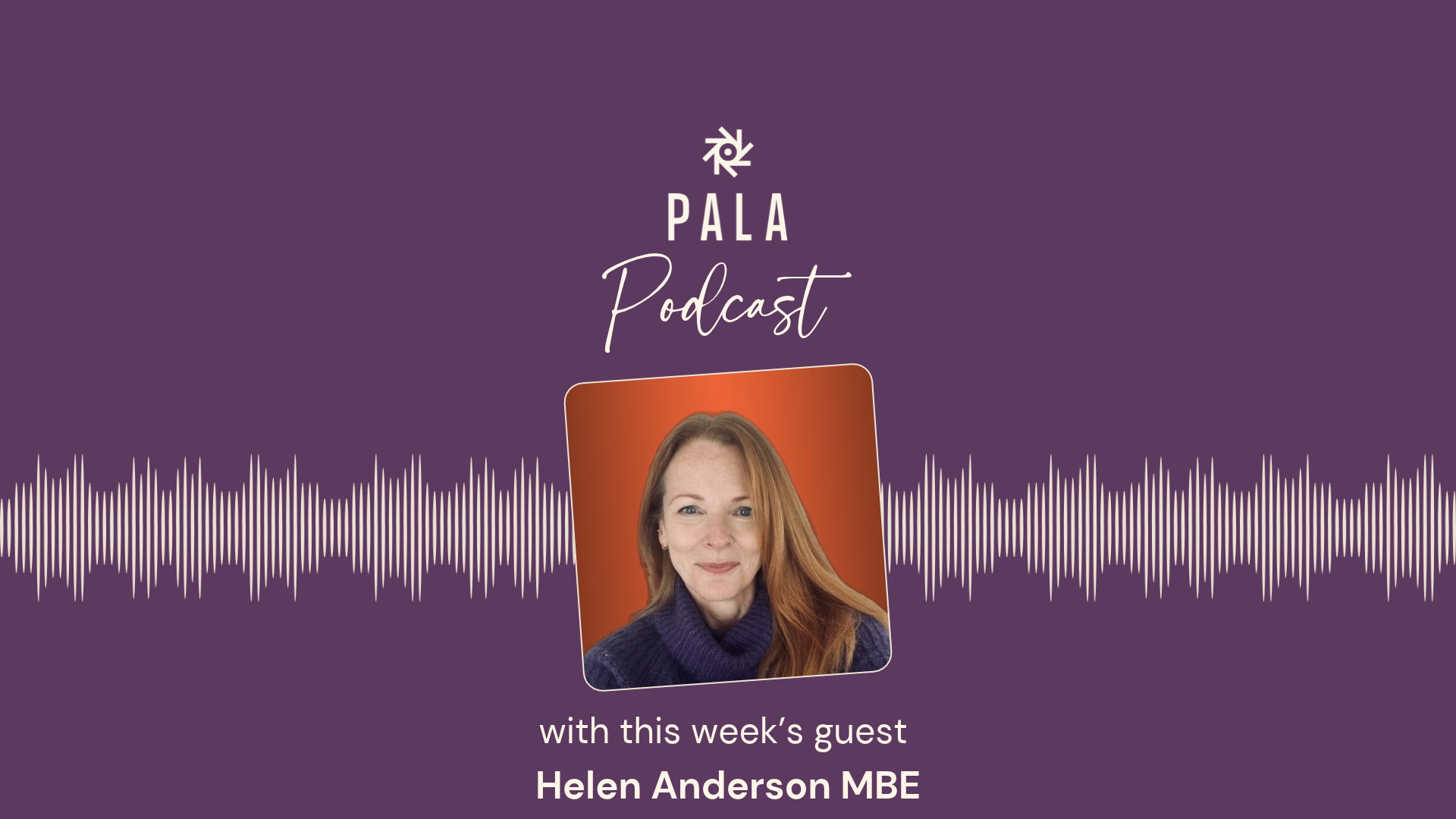
Pala Podcast: How Self-Managed Teams are Transforming Social Care with Helen Anderson
Welcome to our podcast with guest Helen Sanderson
Read more
How High-Performing Organisations Scale Without the Bureaucracy
There are two ways to scale: you can grow fat, or you can grow strong.
Read more