
Why Self-Management Isn't Chaos
The power of coordination and cohesion in self-managed teams

The most common question we hear at Pala is: “But isn’t it just chaos?”
When we help organisations transition to self-managed, autonomous structures—environments with fewer bosses or no bosses at all—skeptics immediately imagine a ship without a rudder. They picture a vacuum where no one leads, no one steers, and no systems exist to support the work.
The reality is the exact opposite.
Self-management does not mean everyone does whatever they like. It means replacing rigid, top-down control with a nurturing, high-performance structure. To succeed, autonomous teams require more discipline, not less. Here is why decentralisation outperforms hierarchy every time.
Distributed Leadership, Not Leaderless
A self-managed organisation is not leaderless, it is leader-full. In traditional models, leadership is a bottleneck. In the models we use with companies, leadership is a distributed function. High-functioning teams co-create their vision, ensuring collective buy-in from the start. When every team member is committed to the “how” and the “why,” the organisation moves faster and with more precision than any top-down mandate could ever achieve.
Systems Over Bureaucracy
To prevent chaos, you must implement rigorous, transparent systems. Self-management fails without structure. We replace closed-door meetings with inclusive, well-facilitated forums where every participant shapes the agenda. We swap information silos for radical transparency—open communication channels where data is accessible to everyone. This isn’t just about being “nice”, it’s about ensuring every person has the information they need to make decisions at the source.
Fluid Roles: Agility as a Standard
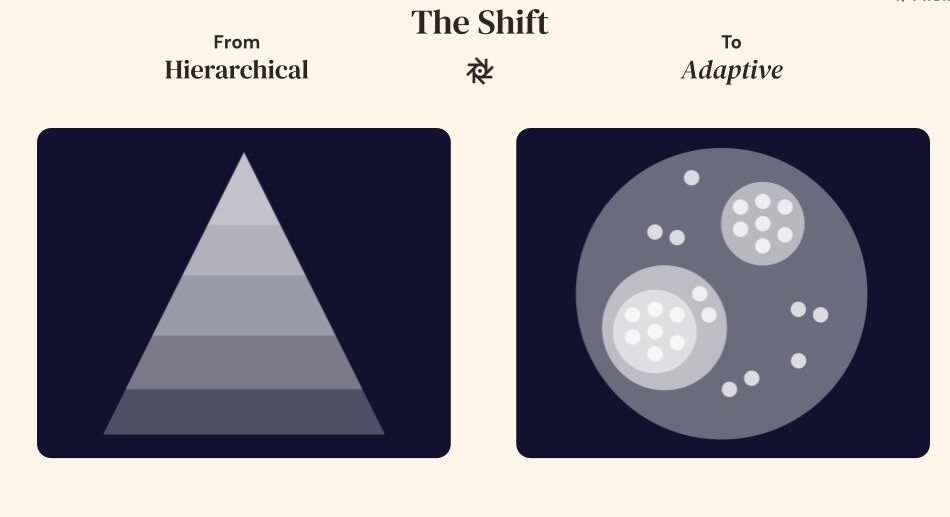
Hierarchies are rigid; self-managed teams are fluid.
In a traditional hierarchy, power moves vertically, and expertise is trapped in job titles. This creates “single points of failure.” At Pala, we organise work around tasks and project teams – autonomy at the source. In an adaptive team, those closest to the work have the power to change it. If a team sees a better way to meet a goal, they adapt instantly rather than waiting for permission.
Skill Optimisation: We move beyond static job descriptions. If your Marketing Executive is a skilled coder, they contribute to the code. This maximises your internal resources and allows your people to grow in real-time.
The Result: Efficiency, Innovation, and Growth
Replacing top-down control with self-regulating processes isn’t a social experiment—it is a competitive advantage.
By allowing for coordination without permission, our clients see:
- Drastic Time Savings: Work gets done faster when you remove the “approval” layer.
- Increased Revenue: Creative freedom leads to innovation, opening new revenue streams that stagnant hierarchies miss.
- Peak Engagement: Highly motivated staff stay longer and work harder when they own their outcomes.
Are you ready to stop managing and start leading?

More epic articles...

Beyond the Carrot: Moving from Behavioural Control to Vertical Development
How we can encourage our teams to sense-make and lead themselves through inner-growth
Read more
The paradox of self-management
Why empowered teams still depend on their leader
Read more