Beyond the Carrot: Moving from Behavioural Control to Vertical Development
How we can encourage our teams to sense-make and lead themselves through inner-growth

In the 50s, the father of modern person-centred psychotherapy Carl Rogers wrote that he feared the power of behavioural psychology. 70 years later, this really was prescient. In his seminal book ‘On Becoming A Person’ he said:
I am afraid of the power of the behavioral sciences… The control of human behavior is a great power, and a direct threat to the human person.
(The Humanist, 1957)
For those of you who might be unfamiliar with this term ‘behavioural’, I’m sure you are familiar with ‘Pavlov’s Dog’ (otherwise known as ‘Classical Conditioning’), perhaps one of the most famous experiments in popular psychology.
Essentially, Pavlov figured out that if a trigger (a bell) was deployed at the same time as a reward (food), then over time the dog would come to associate the trigger with the reward and would salivate from the sound of the bell alone. You’ll also likely be familiar with studies on lab rats using cocaine.
Rogers fear has since become true and it is embedded throughout our society as a mechanism of coercion and control, often in the name of profit. As I detailed in my 2018 short book “Tech Monopolies: A short rant about addictive design”, social media platforms hire behavioural scientists trained at Stanford’s ‘Persuasive Technology Lab’ where they learn how to use triggers to spike our dopamine levels to keep us in the ‘hooked cycle’ (the name of the model created by Nir Eyal which has been used as a blueprint for many of the people designing for digital addiction).
The Limits of Extrinsic Rewards
But you know all this. And most people aware of this find it a bit gross. And yet we don’t blink at children being brought up like Pavlov’s dog. If my teen behaves ‘well’ at school he is given points which give him free snacks at the canteen (I wonder if he’s ever fittingly chosen a carrot as his snack). If he behaves ‘badly’, then he has points taken from him that can lead to detention. We no longer use caning thankfully, but the metaphorical stick is still very much in vogue as a way to get children to behave ‘well’, that is to say to behave as we want them to behave. The definition of conformity.
For all the talk of diversity or neurodiversity, we’ve designed school systems which don’t tolerate deviations from the norm and which create elaborate incentive systems to create conformity.
Yes. The way we teach children is like the way we train dogs.
These behavioural techniques use extrinsic rewards and punishments, and treat the human’s (or dog’s) visible behaviour as the ultimate goal. Their hidden inner world is given no thought.
But I don’t know about you, but I have higher standards of my own child. Perhaps unfairly, it is not enough for me that he behave ‘well’. No. I want him to do so for the right reasons. In fact, I care less about him cleaning up after himself in the kitchen, than I care about him caring and having in his heart a genuine intention to be considerate for his and other’s needs. This is a level of complexity far above him simply putting his plate in the dishwasher.
For example, he might get up from the table after breakfast and say ‘I’m in a rush, so would you mind putting my plate in the dishwasher for me’. In this moment, he is actively NOT putting the plate in the dishwasher, but what he is doing is demonstrating that his inner voice is weighing up several competing factors, including his needs and the needs of the people he lives with.
A long time ago we discussed family chores and we agreed that he would NOT get paid for any chores. And that actually he didn’t HAVE to do the chores. But we’d of course like it if he did. The results of this anti-behavioural experiment currently demonstrate that he is just about average at doing chores, but what he is showing is a genuine willingness to chip in and be thoughtful – that is intrinsic and free of any coercion.
We value where it comes from, more than what he actually does.
And this pedagogical philosophy I’m speaking about is the opposite of behavioural psychology. It is interested in the outer behaviour of the individual only, in as much as it is a downstream reflection of their inner world.
And we understand that their inner world is what we would most like to nurture. This strand of psychology is called developmental psychology.
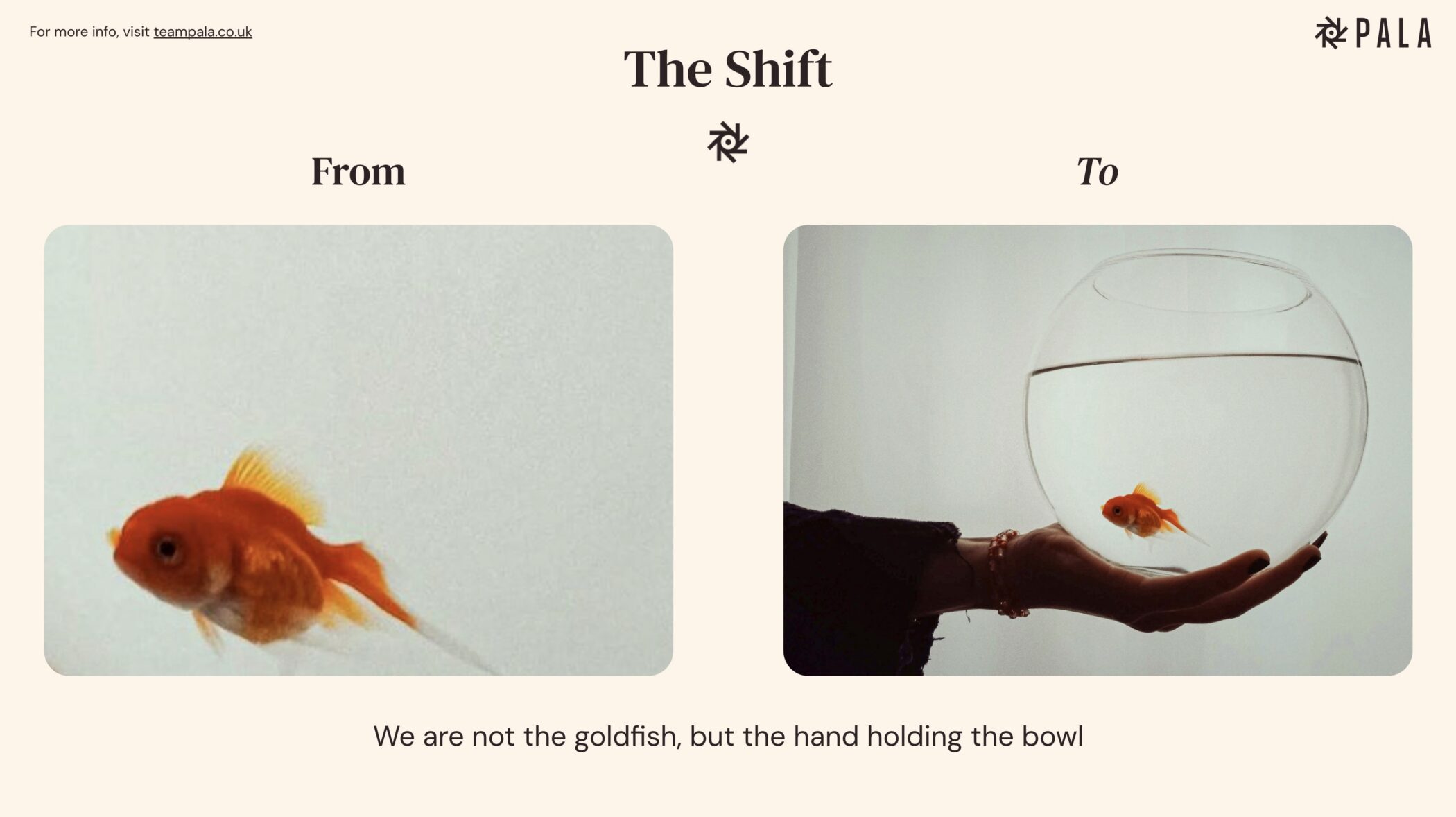
Ring a bell?
The L&D Misnomer
The term Learning & Development (L&D) in our organisation is therefore typically misleading. It should be called Learning & Behaviour for it typically follows the same pedagogical assumptions as with the dogs and the kids.
We go through Diversity, Equality & Inclusion training to teach us how we should behave.
We go on leadership training to teach us about adopting new ‘leadership behaviours’.
And on coaching programmes we sit back and learn so-called ‘active listening’ (a term originally coined by Rogers who ended up disowning the term because it had become a bag of tricks used to pretend we’re listening, rather than focusing on adopting a genuinely empathic, non-judgemental and congruent relationship toward our interlocutor).
There are of course many fantastic programmes out there, but you get my gist.
L&D programmes tend to be concerned by outer behaviour rather than inner development. The programme initiator typically has an agenda and has decided how they would like everybody to behave after the programme. Specifically, most corporate programmes are interested in a subset of learning which is neither behavioural, nor truly developmental and is sometimes known as ‘horizontal development’.
This is the way in which L&D is perhaps most similar to school in that it typically is focussed on the acquisition of knowledge or skills. These are the programmes where we learn new stuff or learn how to do new stuff. And I would argue that whilst these programmes of course have their place, they aren’t enough alone for they are largely still occupied with what a person does in the outer world rather than look inwards into supporting somebody with what is often described as sense making.
That is to say how somebody makes sense of their work, themselves (their thoughts, feelings, actions), their relationships and even with the world.
When this kind of sense making is nurtured, a person is able to understand their context in increasing levels of complexity and this has been found to correlate with leadership effectiveness (Eigel).

Updating the Operating System
You could think of horizontal development as acquiring new apps for your old smartphone. But vertical development of the meaningful variety, is like upgrading the operating system.
Or to use a less mechano-centric metaphor, horizontal development would be like a caterpillar being taught to run faster, where vertical development would be like helping them become a butterfly.
These leaps in development have enormous value in the workplace because sense making is upstream from decision making which is one of the most vital parts of any organisation.
As our sense making develops, we are able to factor in more variables into our decisions, we are able to navigate the social nuances of situations, we are able to hold tensions and trade-offs and we are able to see the role of our mind and biases in how we operate.
We go from being our perspectives, to having perspectives. From being our identities & beliefs, to having our identities & beliefs.
This is genuine autonomy at the deepest level.
We go from being the lab rats running on autopilot, or the child reciting rote memorised nonsense, to having agency of a different order. The type that subsequently enables us to perform at the level of complexity required to excel doing strategic work in this increasingly chaotic 21st century.
And so what of Learning & Development programmes? Well, I’d ‘simply’ suggest bringing in the ‘development’ part a bit more seriously.
The problem is it can’t be taught.
I can’t teach my kid to care about me.
But I can role model.
I can ask questions.
I can give his inner voice a voice at our dinner table.
And if I am patient, and nurturing and honest, over time, I can see differences in his behaviour that didn’t come from me, but came from him as a result of his own choices and his own constantly developing inner world.
Creating Space for Sense-making
And so the same can be true in our teams and organisations.
We must create forums for people to sense-make.
Some in groups where we hear competing perspectives and are forced to make sense of them.
Some in pairs where we are coached rather than advised.
Some alone where we look inwards rather than constantly looking outwards.
Mediation is another fantastic tool for inner development.
But the tools are less important than the sustained and renewed intention to enable somebody to come to their own conclusions rather than guided towards the conclusions of others.
Because when we do this, we nurture the human spirit and we build organisations of free thinkers, and there is little more resilient, creative and alive than this.
If we want to grow our organisations, inner growth must be a top priority, rather than building armies of automatons.
Particularly in a world where we risk being replaced by automation.